Skip to content
John the Gate Man, gate automation specialist in Leyland, Lancashire
Automated driveway gates of the kind installed and serviced across Lancashire

Lancashire service area

Gate Automation Across the Ribble Valley

The Ribble Valley is a district rather than a town, and it is the most rural part of Lancashire by some distance. It covers 583 square kilometres, which makes it the largest district in the county, it has the lowest population density in Lancashire at roughly a third of the England and Wales average, and it has by far the largest number of farm holdings of any Lancashire district. A substantial part of it lies within the Forest of Bowland National Landscape. Clitheroe is the principal town, with Longridge, Whalley, Waddington, Chipping and Slaidburn among the settlements spread across the rest. John the Gate Man works from House Farm in Leyland, PR25 1LE.

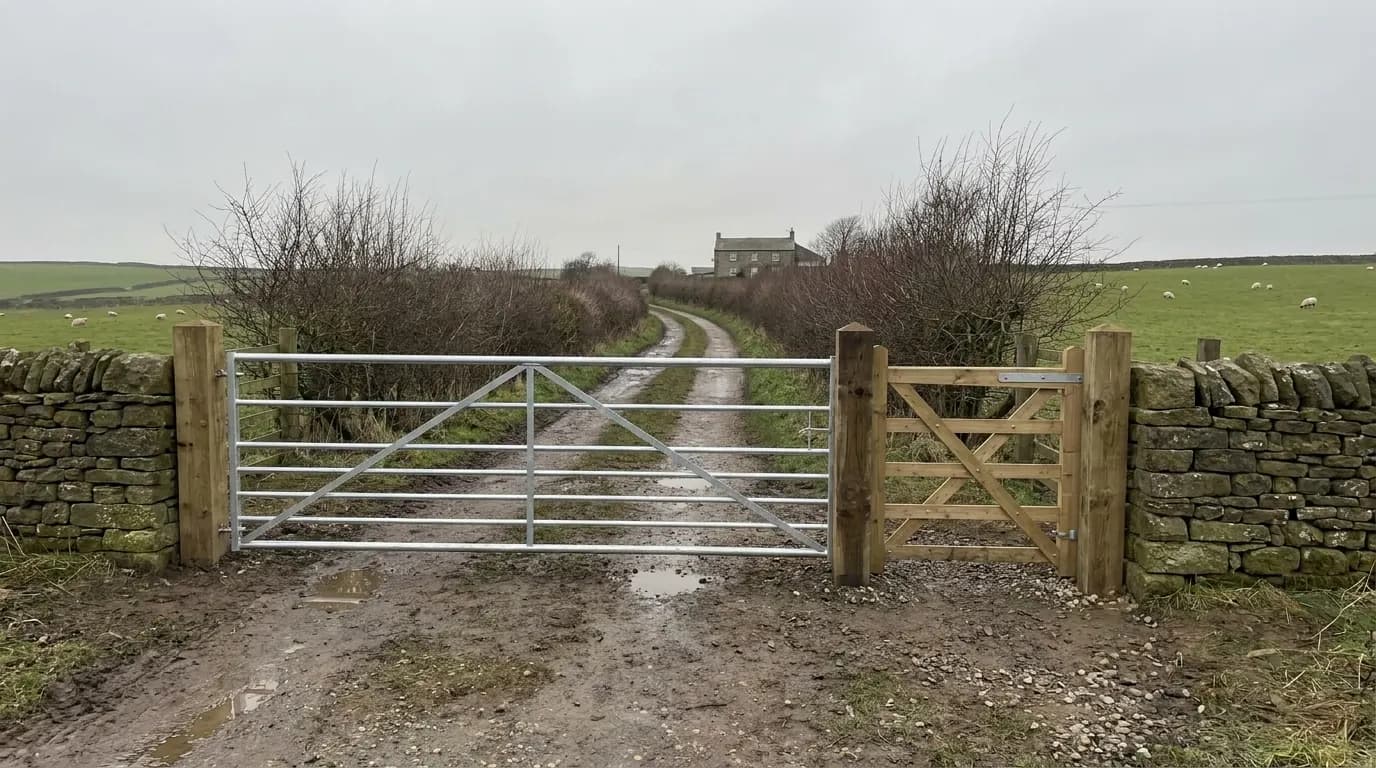
Gate work here is a different problem from gate work in a town, and the reason is distance. Rural entrances are frequently a long way from the house and further still from the nearest convenient power supply, so the first question on a Ribble Valley job is usually not which motor but how the gate is going to be powered and how you are going to know who is at it. Running armoured cable a couple of hundred metres up a track is one answer, a solar supply with a battery is another where the gate is light and the duty modest, and both are ordinary work rather than exotic.

The same distance drives the access control. Where the gate cannot be seen from the house, a conventional wired intercom means trenching the whole run, so systems that call a phone are often the sensible choice: the gate rings a mobile, you speak to whoever is there and release it from wherever you are. Keypads suit deliveries and contractors, fobs suit the household vehicles, and on farm entrances the width of the opening matters as much as the electronics, because agricultural access frequently needs a clear span far wider than a domestic drive.

Gate questions in Ribble Valley

Is the Ribble Valley a town?
No, it is a local government district and a broadly rural area covering 583 square kilometres, the largest district in Lancashire. Clitheroe is its principal town, and Longridge, Whalley, Waddington, Chipping and Slaidburn are among the other settlements. This page covers the district as a whole; there are separate pages for gate work in Clitheroe and in Longridge.
How do you power a gate at the end of a long farm track?
There are two practical routes. The first is to run armoured cable in ducting from the property to the gate, which is the more robust answer and worth doing where the trench is achievable. The second is a solar panel and battery at the gate itself, which suits lighter gates and moderate use and avoids the trench completely. Which is right depends on the gate weight, how many times a day it moves, and how difficult the cable route would be.
How can I answer the gate if it is out of sight of the house?
A system that calls a phone is usually the answer. The intercom panel at the gate dials a mobile, you speak to whoever is there and release the gate from the handset, so it works whether you are in the house, in a field or away entirely. Where there is a usable cable route back to the house, a conventional wired audio or video intercom does the same job with a handset or screen indoors.
What access control suits a rural property?
Generally a combination. Fobs for the household vehicles, a keypad for deliveries, contractors and anyone who arrives without a fob, and an intercom for everyone else. Coded entry is particularly useful on rural entrances because a code can be given over the phone to a delivery driver and changed afterwards, without anyone having to be at the gate.
Can you automate a wide farm entrance?
Yes, though the width is the thing that decides the design. A wide agricultural opening is often better served by a sliding gate, which needs a clear runback along the boundary roughly equal to the opening, or by a pair of leaves with a heavier drive on each. Long single leaves are heavy and take a lot of wind, so on very wide openings a bi-folding or sliding arrangement usually works better than simply making the leaves longer.
Do I need planning permission for gates in the Ribble Valley?
The general rule is that a gate up to one metre high next to a road used by vehicles, or two metres elsewhere on the boundary, is permitted development. Above those heights an application goes to Ribble Valley Borough Council. Permitted development does not apply within the curtilage of a listed building, and in open countryside within the Forest of Bowland National Landscape the visual effect of a boundary treatment is a material consideration, so it is worth checking early.
Does the Forest of Bowland designation stop me having gates?
No, but it does mean the appearance of what you put up matters more. The National Landscape designation is a material planning consideration, so a design in keeping with the surroundings, at a sensible height and in appropriate materials, is far less likely to run into difficulty than something that reads as suburban in open countryside. Ribble Valley Borough Council can advise on a specific site.
Will automatic gates keep livestock in?
A gate keeps stock in only while it is closed, so on a working entrance the important settings are the automatic close timer and what happens after a power cut. It is also worth thinking about where the safety photocells sit, because an animal standing in the beam will hold the gate open exactly as a person or a vehicle would. Those are commissioning decisions, and they should be made deliberately for a stock entrance rather than left at the default.
How exposed is too exposed for a solid gate?
There is no single height or wind speed that decides it, but the higher and more open the site, the more heavily a solid leaf is loaded and the more that load has to be carried by the frame, the hinges, the posts and the drive. On exposed ground it is usually better to choose an open or slatted design, or to accept that a solid gate needs a heavier frame, deeper posts and a drive with real margin above the still air weight.
Do the gate safety rules apply on a farm?
Yes, and on a working farm they apply more strictly rather than less. A powered gate is classed as machinery in law, so the trapping and crushing risks have to be designed out, appropriate safety devices fitted and the closing forces measured against BS EN 12453. Where the gate is part of a workplace there is also a duty to maintain and inspect work equipment, which sits on top of the general obligation on the owner or occupier.

Gate work in Ribble Valley?

Call 07768 314082 to talk it through, or send the details and get a call back.

Call nowQuote